How to Identify Fake Followers on Accounts
Last Updated on January 25, 2026 by Ethan
To identify fake followers Instagram accounts are padded with, you’re basically looking for patterns that don’t make “human” sense: weird engagement, low-quality profiles in clusters, and follower growth that spikes like a heart monitor.
I’ve checked thousands of accounts over the years (mine, clients, random influencers brands wanted to vet), and the giveaway is almost never one single thing. It’s the combo: lots of followers, thin engagement, and a follower list that looks like it was generated by a keyboard smash.
Below I’ll walk you through what actually works in 2026, how Instagram’s purges affect what you see, and a simple “scorecard” you can use to sanity-check any account before you trust its numbers.
The reality of fake followers in 2026 (it’s worse, but also easier to spot)
Instagram has been cracking down hard. Fake followers and fake engagement aren’t just “cringe,” they’re risk. I’ve watched accounts get their reach quietly crushed after a bot-buy, and the owner swore nothing changed… except their Reels suddenly stopped landing on Explore. Yep.
Here’s what’s wild: the industry numbers basically match what I see in audits. A meaningful chunk of engagement out there is junk, and brands keep bleeding money into it. That’s why so many teams now do follower-quality checks before they even talk pricing.
And for creators? Buying followers is still the #1 account killer I run into. Not because Instagram “hates you,” but because the algorithm reads the room: if your audience doesn’t respond like real people, your content looks like it’s not worth distributing.
How fake followers actually “work” (and why they mess up your account)
Most fake followers aren’t one thing. You’ve got a few types, and each leaves different fingerprints:
- Bots: auto-created accounts that follow thousands of people, leave generic comments, and get purged in waves.
- Click-farm accounts: real humans running piles of accounts, swapping follows/likes to simulate activity. Looks “more real,” but patterns still show.
- Dead/ghost accounts: abandoned users, inactive profiles, or accounts that got flagged and quietly stopped showing up normally.
- Incentivized followers: giveaways and “follow-for-follow” crowds. Not always fake, but engagement quality often behaves like it.
The mechanism is simple: Instagram learns what kind of audience you attract. If you bring in low-signal followers (bots, click-farms, or people who never engage), your posts get weak early engagement. Weak early engagement tells the system “don’t push this.” And then people wonder why growth stalls.
Counterintuitive thing nobody tells you: a smaller account can be “more suspicious” than a big one. I’ve seen 4,000-follower pages with engagement so unnatural (same 12 accounts liking every post within 60 seconds) that it screamed automation, while some 300k accounts looked clean because their audience behavior was messy in a normal way.
The fastest way to check for fake followers (my practical 10-minute audit)
If I only have 10 minutes to vet an account, here’s what I do. Not theory. This is the exact flow I use when a brand manager pings me “can you sanity check this creator?”
1) Do the engagement math (but don’t obsess over one number)
Look at the last 9 to 12 posts, not the “best” pinned ones.
- Red flag: 100k followers and 150 likes per post. That’s roughly 0.15%. Oof.
- Also a red flag: comments that are oddly repetitive, like “Nice pic” or a wall of identical emojis across multiple posts.
If you want to go deeper on the math side, this walkthrough on how to track Instagram engagement rate is the cleanest way I’ve found to avoid misleading calculations.
And yes, engagement varies by niche. Meme pages, celebrities, and “link in bio” businesses all behave differently. Still, extremely low engagement compared to follower count is one of the loudest signals.
2) Check comment quality, not just the count
Fake followers Instagram sellers love to bundle “engagement” too. So you’ll see 40 comments, but they read like a broken chatbot.
What I watch for:
- Comments that don’t reference the actual post (generic praise on everything).
- Clusters of accounts commenting within seconds of each other, every time.
- Profiles with strange usernames (lots of numbers, random letters), no profile pic, and no posts.
One lived-detail thing: on accounts that bought bots recently, the comment section often has a “burst” pattern. You’ll see a bunch of low-effort comments in the first 2 minutes, then nothing for hours. Real audiences usually trickle in.
3) Open 20 to 50 random followers and look for patterns
This is boring. It works.
Pick followers from different parts of the list (top, middle, near the end). Then ask:
- Do these profiles have posts, Stories highlights, tagged photos, or any real history?
- Do they follow 3,000 accounts but have 12 followers?
- Do you see the same bio template repeated?
Here’s what actually happens on larger accounts: Instagram loads followers in chunks and sometimes fails to show the “freshest” mix consistently. So if you’re auditing a 500k+ account, sample more profiles than you think you need. I learned that one the hard way after missing a bot wave that was obvious once I scrolled deeper.
4) Look at growth shape: smooth is good, jagged is suspicious
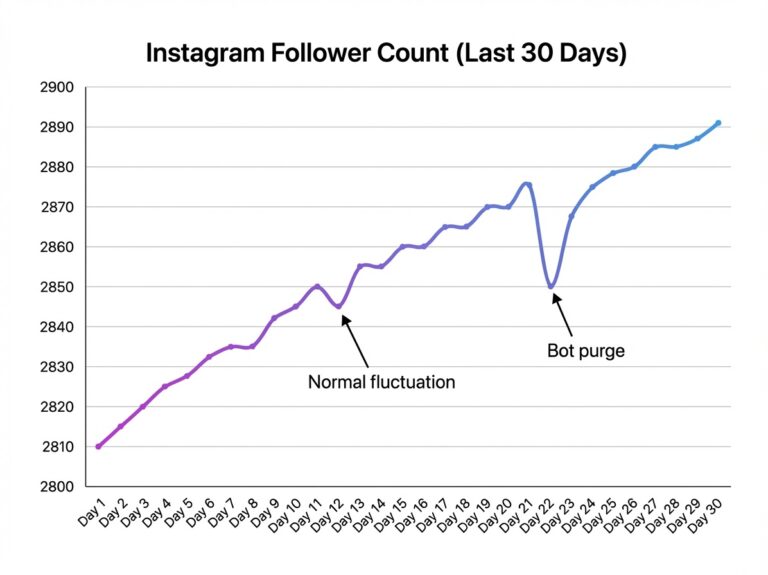
Sudden spikes followed by sudden drops are classic “bought followers + purge” behavior. Instagram does regular cleanups, and bot-heavy accounts get hit harder when those waves roll through.
If you have access to historical follower changes, you can spot this fast. When I’m tracking accounts daily, the suspicious ones don’t just grow fast. They grow fast in cliffs.
5) Use a tracker for public accounts (without handing over your password)
For ongoing monitoring, I like tools that don’t require logging in. I’ve seen too many people hand credentials to random apps and then wonder why their account starts liking weird posts at 3 a.m. Not fun.
If the account is public, UnfollowGram Follower Tracker is a solid option for keeping tabs on who’s coming and going, and it’s especially useful when you’re trying to confirm if weird follower drops match up with low-quality followers getting purged.
Another lived-detail thing: on smaller accounts (under 5k), you’ll notice fake followers “stand out” more because a few hundred bots can visibly change your engagement rate overnight. On bigger accounts, it’s more like a slow leak unless the purchase was massive.
Red flags I always watch for (the ones people keep missing)
A lot of guides repeat the same generic stuff. Here are the signals that actually hold up when you’ve audited a ton of accounts:
- Embarrassingly low engagement for the follower count. Not “low for the niche,” but low in a way that makes you raise an eyebrow.
- Followers with empty profiles in clusters. One or two? Normal. Fifty out of a random sample of 50? Come on.
- Weird geo and language mismatch. Local business in Dallas, but a huge chunk of followers have bios in unrelated languages and no local signals.
- “Engagement pods” that look robotic. Same accounts liking/commenting every post, always early, always the same tone.
- Following-to-follower ratios that scream automation. Like: follows 7,500, has 34 followers, 0 posts.
If you want a good outside breakdown of fake engagement patterns (especially comment spam and inflated metrics), this piece is worth reading: how to tell if an influencer has fake engagement.
Diagnostic reasoning: why these checks work
Instagram is a recommendation system. It’s trying to predict who will care about a post. Fake followers don’t behave like people who care, so they poison the prediction model.
That’s why the “follower list audit” and “engagement behavior audit” work together. A bot-heavy audience changes both:
- Input quality: your follower base is full of accounts that don’t scroll normally, don’t watch normally, don’t tap normally.
- Output signals: your posts don’t get normal saves, shares, profile clicks, and meaningful comments.
And when Meta runs purges, the cleanups don’t just remove followers. They also reshape your audience composition, which is why some accounts see random dips in reach after a purge. The algorithm basically has to “re-learn” who your real audience is.
Where this gets weird (failure modes I’ve seen in real audits)
Some situations break the usual rules. If you don’t know these, you’ll mislabel legit accounts as fake, or miss the fraud entirely.
Failure mode #1: Viral Reels can mimic “fake follower” growth
You’ll sometimes see a real account blow up overnight. The followers come fast, engagement lags, and the audience looks random. That can be legit.
The difference is what happens next: real viral growth usually stabilizes into a new normal over a few weeks. Bought followers often lead to jagged growth and then a sudden drop when Instagram cleans house.
Failure mode #2: Giveaway audiences look fake even when they aren’t
I’m not a huge giveaway fan (I’ve run them, I regret a couple), but they can create a follower base that behaves like bots: low intent, low engagement, quick unfollows.
So if you’re auditing an account that just did a big giveaway, don’t jump straight to “they bought bots.” Check the timing and the content context.
Tools and methods that help (and what I actually trust)
Manual checks catch a lot, but tools speed it up.
- Engagement analyzers: These help you see engagement distribution across posts, not just averages. (Averages hide a lot.)
- Public-profile audits: If you’re tracking follower movement over time, you can spot purge patterns and suspicious spikes.
- Instagram-native data: Great for your own account, obviously limited for competitor audits.
If you’re deciding between Instagram’s built-in numbers and third-party platforms, this breakdown of Instagram Insights vs third party tools is the conversation I end up having with clients constantly.
One more external resource that’s surprisingly practical: this overview of Instagram follower tracker tools does a decent job explaining why different trackers show different results depending on what data they can access.
Common mistakes people make when judging fake followers
I’ve made a couple of these myself. Painfully.
- Obsessing over a single “safe” engagement rate. There isn’t one. Different formats and niches behave differently.
- Only checking one post. One post can flop for totally normal reasons. Check a batch.
- Assuming big accounts are always dirty. Some of the cleanest audiences I’ve seen were on large creators who built slowly for years.
- Calling inactive followers “fake”. Inactive doesn’t always mean fake. Some people just lurk.
- Not accounting for posting time. If you post when your audience is asleep, your early engagement looks awful and it can mimic “fake audience” symptoms. If timing is a question, use something like best times to post based on followers to stop guessing.
Honestly, I used to judge accounts too harshly on comments alone. Then I worked with a creator whose audience just… didn’t comment much. They saved and shared like crazy though. That’s when I stopped treating “comment count” as the main proof.
Limitations: what these methods won’t tell you
This stuff isn’t magic, and I don’t want to pretend it is.
- You can’t perfectly prove intent. Some fake-looking accounts are real people who never post. Some “real-looking” accounts are purchased aged accounts.
- Private accounts are harder to evaluate. You can still analyze engagement and patterns, but you won’t get the same visibility into follower quality.
- Short-term audits miss slow fraud. If someone buys small batches monthly, a one-time check might not catch it. Daily or weekly monitoring is where the pattern shows.
Your mileage will vary, especially on niche accounts where engagement norms are weird (finance, crypto, certain meme verticals). That’s just the reality.
What to do if you find fake followers (on your account or someone else’s)
If it’s your account and you bought followers in the past, I’m not here to shame you. I’ve seen plenty of smart people do it once, panic, then spend months digging out. It happens.
If it’s your account
- Stop the bleeding: cancel any growth service immediately.
- Don’t mass-remove followers in a frenzy: aggressive cleanup can look spammy. Go gradual if you’re pruning.
- Shift content toward high-intent signals: saves, shares, DMs, profile taps. Posts that invite real actions.
- Watch your follower movement: when purges happen, your count may drop. That’s not always “bad,” it can be the trash taking itself out.
If you’re vetting someone for a brand deal
Ask for story link clicks, saves, and audience breakdowns. And compare claims to what you see publicly. If the account has 250k followers but can’t show meaningful downstream action, that’s usually the real story.
For a broader view of what metrics matter (and what’s mostly vanity), this Instagram follower analytics complete guide is a useful reference to keep your audits consistent.
If you’re focused on growing the right way, I also like this external read on safe strategies for getting Instagram followers in 2026. It’s basically the opposite of the “buy followers” mindset.
FAQ
How to check if Instagram followers are fake or real?
Compare follower count to recent engagement, scan a sample of followers for empty or spammy profiles, and look for sudden growth spikes followed by drops (purge patterns).
What’s a “bad” engagement rate that suggests fake followers?
There’s no single cutoff, but if an account has a large following and consistently sits around 0.1% to 0.3% engagement on regular posts, I treat it as suspicious and investigate further.
Can you have fake followers without buying them?
Yep. Bots can follow you on their own, and giveaways can pull in low-quality followers that behave like fake audiences even if they’re real people.
Do fake followers get you banned on Instagram?
Buying them absolutely increases risk. I’ve seen reach suppression and occasional account action after obvious bot activity, especially when it’s paired with spammy automation.
Are follower checker tools accurate?
They’re directionally helpful, not perfect. Some tools can’t see private data, and slow “drip” fraud can slip through unless you monitor over time.
Bottom line (and a practical next step)
Fake followers Instagram accounts are built on usually show the same fingerprints: thin engagement, low-quality follower profiles, and growth that looks like a staircase instead of a trend line. When you check those three areas together, you can spot most fraud fast.
If you want to keep an eye on follower changes day to day (especially around purge periods), use a tracker and watch for patterns instead of obsessing over one-off dips. And if you’re serious about keeping your audience clean long-term, it’s the boring stuff that wins: consistent content, real engagement, and steady growth.
For ongoing monitoring, UnfollowGram’s app and tools are a solid way to keep tabs on follower movement without handing over your password. Check out UnfollowGram and make it part of your weekly routine.

Ethan is the founder of UnfollowGram with more than 12 years of experience in social media marketing. He focuses on understanding how Instagram really works, from follower behavior to engagement patterns, and shares those insights through UnfollowGram’s tools and articles.