Weekly vs Monthly Follower Tracking
Last Updated on January 25, 2026 by Ethan
If you’re trying to grow on Instagram, you should track followers weekly, then zoom out with a monthly check for the bigger trend. Weekly tracking catches what content actually moved the needle, while monthly tracking keeps you from panicking over normal ups and downs.
I’ve tested this on everything from tiny creator accounts (a few hundred followers) to bigger pages (tens of thousands), and the pattern is pretty consistent: the people who only look once a month miss the “why,” and the people who stare at daily numbers end up making chaotic changes that don’t help. Been there. It’s not fun.
So here’s the real comparison: what you gain by tracking weekly vs monthly, how to set up a system that doesn’t waste your time, and which tools are actually safe to use in 2026.
Weekly vs monthly tracking: what you’re really measuring
Follower count is just a result. The question is: a result of what?
Weekly tracking is basically a “content feedback loop.” You post, you run a collab, you change your format, you see what happened within a few days, and you can adjust before you’ve burned a whole month.
Monthly tracking is more like “trend confirmation.” It’s slower, but it’s calmer. It’s the view that tells you whether the account is truly compounding or just bouncing around.
What weekly tracking is best for
- Spotting content-driven spikes (Reels that suddenly hit Explore, a carousel that got saved a lot, a story series that pushed profile visits)
- Seeing churn early (a format change that makes your existing followers quietly unfollow, which you won’t notice until it’s a bigger problem)
- Campaign measurement (giveaways, paid shoutouts, collabs, launches)
- Staying honest about momentum without obsessing every day
What monthly tracking is best for
- Separating noise from signal (one weird week doesn’t define your account)
- Comparing one month to the last when your posting schedule is consistent
- Budget decisions if you’re spending on ads, creators, or editing
And here’s the counterintuitive part nobody tells you: weekly tracking usually makes you less reactive, not more, if you stop looking at daily swings. You’d think “more tracking = more stress,” but if you only review once per week, you actually stop spiraling over Tuesday’s random dip.
How follower tracking works (and why timing matters so much)
Follower tracking is basically a before-and-after comparison of your follower list and follower count, tied to a time window (7 days, 30 days, etc.). Instagram is constantly processing follows/unfollows, bot removals, and privacy changes, so the “truth” is always a moving target.
The reason consistent timing matters is simple: Instagram’s visible count and list updates don’t always sync perfectly in real time. If you log at 9am one day and 11pm the next, you’re not comparing the same kind of “moment” in your audience cycle.
Lived detail: on accounts I manage that post late evening, the next morning often shows a small follower bump that wasn’t there right after posting. If you only check randomly, you’ll swear the post “did nothing,” then a day later it looks like magic. It’s not magic. It’s timing and delayed discovery.
The actual tradeoff: weekly vs monthly (no fluff)
Weekly tracking gives you clarity faster
When you track followers weekly, you can line up what happened with what you did. That’s the whole game.
Example: if you ran a collab on Thursday and by Sunday you’re up +120 followers, that’s actionable. If you only check at month-end, you’ll see “+310 this month” and have no idea which activity mattered.
Monthly tracking protects your brain
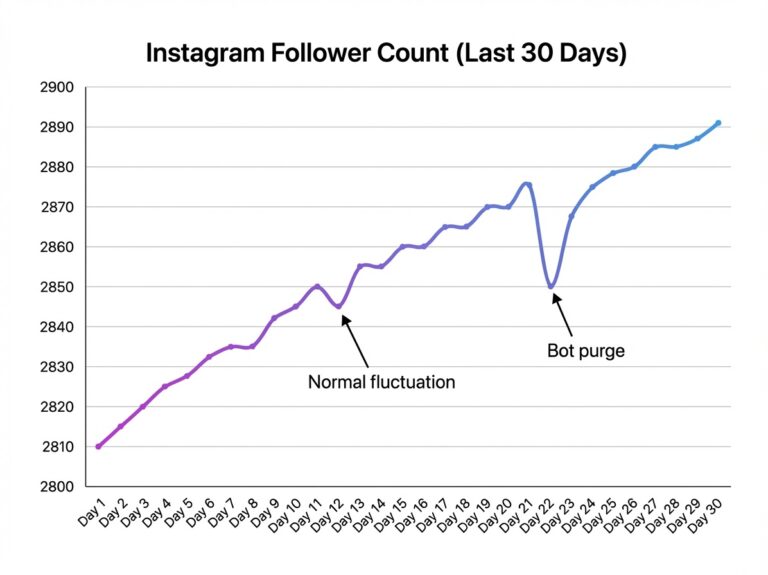
Instagram has normal micro-churn. People clean up their following list. Spam gets removed. Some folks follow after one Reel, then unfollow a week later when they’re in a “declutter” mood. It happens.
Monthly tracking smooths those bumps out. Especially if you’re in a seasonal niche, it also helps you avoid blaming yourself for normal cycles.
Weekly tracking can expose problems early (before they’re expensive)
I’ve seen this a lot with creators who suddenly pivot content. The follower count might still rise overall, but the unfollow rate quietly climbs. Weekly tracking makes it obvious sooner.
Lived detail: on larger accounts, weekly numbers tend to look “choppier” because Instagram also sweeps spam accounts in waves. You’ll get a random down day that isn’t your content’s fault. That’s why you compare week-over-week, not day-over-day.
My “sweet spot” system (what I actually do)
I don’t pick weekly or monthly. I do both, but in different ways.
Here’s the setup I’ve ended up with after trying way too many dashboards, apps, and “analytics suites” that promise the world and give you… a pie chart. Meh.
- Log follower count daily at the same time (takes 30 seconds). Pick a time you can stick to, like 9am.
- Write down what you posted (Reel, carousel, story series), plus anything that could affect growth (collab, giveaway, paid boost).
- Do a weekly review: net change, best content, worst content (yep), and one hypothesis for next week.
- Do a monthly review: compare the month to last month, check audience demographics shifts, and decide what to double down on.
I know daily logging sounds like overkill. I used to roll my eyes at it too. Actually… I avoided it for years because it felt nerdy.
But daily logging fixes one of the biggest problems in tracking: you can’t do real diagnostics if you only have two data points (start of month and end of month). You need a simple “timeline” to attach causes to effects.
Tools that work in 2026 (and the ones that get you into trouble)
You’ve basically got three buckets: Instagram’s built-in Insights, safe public-data tools, and risky third-party apps that want your login. That last bucket is where people get burned.
1) Instagram Insights (free, but limited history)
Instagram Insights is the first place I check, because it’s “source of truth” for a lot of account-level metrics. In 2026, it’s pretty good for quick windows like 7, 14, 30, or 90 days.
But it has a big limitation: you don’t get unlimited historical storage beyond what Instagram decides to show you. If you want to compare “this month vs the same month last year,” Insights alone won’t save you.
If you want a deeper framework for reading those numbers, this pillar page is solid: Instagram follower analytics complete guide.
2) Public-account follower tracking (safe approach)
For public accounts, tools that pull public lists can be useful for tracking changes without asking for your password. That’s why I like options that don’t touch private account data and don’t require login access.
I’ll be blunt: I trust tools more when they don’t want my credentials. Period.
That’s also where UnfollowGram Follower Tracker fits in nicely for public accounts: quick checks, no password, and it’s the kind of tool you can use without that “am I about to get locked out?” feeling. Simple.
3) Competitor trend tools (for context, not obsession)
When someone asks me “is my growth normal,” I usually want a benchmark. Not a universal benchmark (those are mostly fake), but a niche benchmark.
Social Blade is the classic for basic competitor tracking. It’s not perfect, but it gives directional context. If you want a broader overview of different approaches to tracking, I’ve also seen decent breakdowns like this guide to tracking Instagram followers and roundups like analytics tools lists for 2026.
Quick tangent: competitor tracking is useful, but don’t let it mess with your content brain. I’ve watched creators copy a competitor’s posting style because “they’re growing faster”… even though the competitor is running paid ads the creator doesn’t know about. Awkward.
What to track weekly (besides the follower number)
If you only track followers, you’re missing the mechanism behind growth. Followers are the outcome. You want the inputs too.
- Net follower change (new follows minus unfollows)
- Profile visits (often the best “bridge” metric between reach and follows)
- Top content that week (by reach and by saves/shares)
- Engagement rate (because follower growth with declining engagement can be a red flag)
- Posting cadence (how many posts, and what formats)
If you want the clean way to calculate engagement, link it to follower growth, and not get fooled by vanity reach, this page helps: how to track Instagram engagement rate.
The “weekly review” that doesn’t waste your Sunday
This is what I do with clients, and it’s fast. Like 10 minutes fast.
- Check net follower change for the week. Don’t overthink it.
- List the week’s posts and mark any outliers (one Reel did 10x the others, one carousel tanked).
- Pick one reason the outlier likely happened (hook, topic, shareability, collab, timing).
- Decide one test for next week. One. Not five.
Vulnerable moment: I used to stack “tests” like a maniac. New captions, new editing style, new posting time, new niche angle, new everything. Then I’d stare at the numbers and learn nothing because I changed too much at once. Classic mistake.
The monthly review: where strategy actually gets decided
Monthly tracking is where you answer the bigger questions:
- Are we growing faster, slower, or flat compared to last month?
- Which format is carrying the month (Reels, carousels, stories)?
- Did audience demographics shift?
- Are we attracting the right people, or just “more people”?
And timing matters here too. If you want to connect follower growth to posting windows, you’ll get more value by pairing your monthly review with your “when should I post” insights. This page goes deep on that: best times to post based on followers.
Common mistakes that’ll wreck your tracking (I’ve watched it happen)
- Logging at random times. This is the fastest way to create fake volatility in your data.
- Comparing day-to-day. Daily swings will drive you crazy. Week-over-week is where patterns show up.
- Ignoring engagement. I’ve seen accounts grow followers while the audience quality drops. It looks “good” until sales or DMs dry up.
- Not writing down what you posted. Then you can’t explain spikes, so you can’t repeat them.
- Using sketchy unfollower apps that want your password. This is where people end up locked out, or suddenly following 1,200 accounts they never followed. Yep, really.
If you’re still deciding how much to rely on Instagram vs external tools, this comparison is useful: Instagram Insights vs third party tools.
Failure modes: where weekly or monthly tracking breaks
1) It falls apart when you change too many variables
New niche, new format, new posting schedule, new hashtag strategy, plus a giveaway? Your data becomes a soup. You can’t tell what caused what.
If you’re going to run a “month of change,” fine. Just accept that your tracking that month is more like documentation than diagnostics.
2) It gets weird during spam sweeps or sudden algorithm shifts
Every so often, Instagram purges spam accounts, or something changes in distribution and a ton of creators see reach wobble at the same time. In those weeks, follower changes can look “off” compared to your content quality.
This is why competitor context helps. If every similar account dips that week, it’s probably not your hook. It’s the platform.
Limitations (real talk)
- Weekly and monthly tracking won’t tell you exactly why one person unfollowed. You can make educated guesses, but you can’t read minds.
- Public-account tools can’t see private accounts the same way. If an account goes private, data access changes, and your history can get patchy.
Also, your mileage may vary if you’re in a niche with heavy bot activity (crypto, giveaways, “follow for follow” circles). The follower number moves, but it doesn’t always mean real audience growth. Annoying, I know.
So… should you track followers weekly or monthly?
If you’re actively posting and trying to grow, track followers weekly. It’s the best balance of speed and sanity.
If you’re posting casually or you’re in a stable “maintenance mode,” monthly tracking might be enough. Just don’t expect it to teach you much about which posts worked.
My default recommendation for most creators and managers is: daily logging, weekly review, monthly strategy check. It sounds like a lot, but once it’s a habit, it’s basically autopilot.
FAQ
Is there a free Instagram follower tracker?
Yes. Instagram Insights is free, and some tools offer free public-account tracking or limited reports. Just be picky about anything that asks for your password, because that’s where risk usually shows up.
Is Snoopreport legal to use?
Legality depends on your country and what data is being collected, but the bigger issue I see is compliance and ethics. Tools that track other users’ activity can cross platform rules or privacy expectations, so I treat them as high-risk even if they “work.”
Is “not just analytics” free to use?
Some analytics products offer a free tier or a trial, but the free version usually has limits (history caps, fewer accounts, delayed data). Check the current pricing page and assume anything advanced is paid.
Should I track followers daily?
Log daily if you can do it in under a minute, but don’t interpret it daily. Use daily logs to make your weekly review more accurate.
Why did my followers drop even though my content is better?
It can be normal churn, spam removals, or a format shift that attracts new viewers but doesn’t match what old followers wanted. Weekly tracking paired with engagement metrics usually reveals which it is.
Conclusion (and a practical next step)
Weekly tracking gives you fast feedback you can act on. Monthly tracking gives you the calm, zoomed-out truth. If you combine them, you stop guessing and start making changes based on patterns you can actually see.
If you want a simple way to check public-account follower changes without handing over your Instagram password, try UnfollowGram at unfollowgram.com. Keep it boring, keep it consistent, and your tracking will finally start making sense.

Ethan is the founder of UnfollowGram with more than 12 years of experience in social media marketing. He focuses on understanding how Instagram really works, from follower behavior to engagement patterns, and shares those insights through UnfollowGram’s tools and articles.